Share:
Bridging the gap between policy and people.
Bridging the gap between policy and people.


In a quiet apartment in a busy city, a woman prepares for her first work meeting of the day, her mind preoccupied with nursery plans and a new, overwhelming awareness of her own health. At the same hour, in a small village miles away, another woman begins her day with a familiar exhaustion, wondering if her fatigue is just a part of the journey or something more. While their surroundings are different, both have just entered a phase of life that is as demanding as it is significant. Their stories-representing millions across the country-are a reminder that for the transition into motherhood to be successful, it must not come at the cost of a woman’s own well-being.
Ensuring this safety is an essential requirement for a thriving future. This journey actually begins much earlier than it is often recognised. Before pregnancy is even confirmed, a woman’s nutritional status, existing health conditions, and level of awareness already influence potential outcomes. Entering this phase with adequate preparation strengthens the foundation on which both maternal and child health depend. In this sense, safe motherhood is not incidental-it is built through early attention and informed choices. These choices, however, are often shaped by the circumstances a woman lives within, making awareness and access is equally important.
From Crisis to Continuity: India’s Maternal Health Transformation
To understand the current state of maternal health, we must look at how far we have come. In the 1990s, India’s Maternal Mortality Ratio (MMR) was a staggering 556 deaths per 1,00,000 live births. Back then, pregnancy was far more unpredictable, often hindered by a lack of infrastructure and awareness.
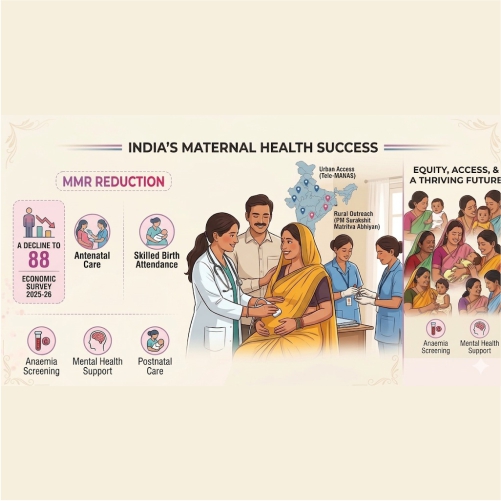
Today, that number has dropped to approximately 88 (Economic Survey 2025-26). This reflects an 84% decline, moving us from a time of crisis to a focus on prevention and continuity. However, ensuring this progress reaches every household is not just a matter of care, but an essential requirement for a thriving future.

MMR in India: A Steady Decline (2014–2020) | Source: Press Information Bureau, Government of India
Antenatal Care: The First Line of Protection
As pregnancy progresses, Antenatal Care (ATC) becomes the primary way health is monitored. Within a woman’s body, another life develops in complete dependence on her health. Early registration and regular check-ups help identify potential risks before they turn into serious complications.
The Pradhan Mantri Surakshit Matritva Abhiyan ensures women have access to periodic visits, allowing for early observation of nutritional gaps and fetal growth. These regular touchpoints bring consistency, yet continuity remains uneven-less than half of women complete the full cycle of care due to existing daily responsibilities. Research reveals the depth of this gap, women without formal education are 40% less likely to utilise the full continuum of care, while those from the poorest households are 35% less likely to do so compared to their wealthier counterparts-a reminder that access to care is as much a question of equity as it is of availability (Tripathi et al., 2024).
Anaemia: The Silent Burden on Maternal Health
Among the conditions that often surface, anaemia remains one of the most widespread challenges. In India, nearly 52.2% of pregnant women are anaemic (NFHS-5). Many begin pregnancy with limited nutritional reserves, which can affect strength and recovery. To address this, Anemia Mukt Bharat focuses on ensuring that supplementation and dietary counselling remain part of ongoing care rather than one-time interventions.
Beyond the Physical: The Overlooked Mental Health Dimension
The emotional experience of pregnancy is as significant as the physical one. Hormonal changes, uncertainty, and shifting routines can affect mental health in ways that are rarely discussed. Studies indicate that around 14% to 22% of women in India experience postpartum depression. Without support, this can affect the bond between mother and child and the overall health of the family.
To address this, there is an increasing recognition of the need for mental health support. Services like Tele-MANAS now provide accessible, judgment-free counselling, allowing women to seek help for emotional distress without the barriers of stigma or travel.
From Birth to Recovery: Safeguarding the Critical Transition
The journey moves towards childbirth-a moment that brings together months of preparation. This stage is safest when supported by skilled healthcare professionals and appropriate facilities. For many, this is tied to financial conditions; the Pradhan Mantri Matru Vandana Yojana provides assistance that allows women to prioritise rest and nutrition.
However, the process does not end at delivery. The days following childbirth require intense attention as the body recovers and adjusts to new responsibilities. To ensure this transition is safe, the Janani Shishu Suraksha Karyakram (JSSK) provides essential, zero-cost care for both mothers and newborns, ensuring that financial barriers do not prevent life-saving postnatal care.
Safe Motherhood: A Collective Commitment to the Future
Safe motherhood is not a single achievement; it is a continuous thread of care that weaves through a woman’s entire life.
Ultimately, maternal health is the truest reflection of a society’s strength. When we ensure that every mother-regardless of her pincode-has access to quality care, we aren’t just saving lives; we are investing in the potential of every generation to follow. Safe motherhood is a shared responsibility, a commitment to ensuring that the act of bringing life into this world is always met with the dignity, health, and respect it deserves.
Author: Himani Kapta
Intern, Pinaca India