Share:
Bridging the gap between policy and people.
Bridging the gap between policy and people.


When we speak about science on National Science Day, we often think of laboratories and research institutions. Yet science is equally present in fields where crops are grown and where decisions on spray precision, timing, and water use directly affect yield. In agriculturally dominant states like Punjab and Haryana, precision agriculture is no longer optional; it is necessary.
Punjab and Haryana remain central to India’s food system. Their farming systems are irrigation-dependent, input-intensive, and time-sensitive. In many districts, groundwater is being withdrawn faster than it can recharge, increasing irrigation costs and long-term stress on water resources. Fertiliser and pesticide use per hectare remains high. In such systems, the method of input application is as important as the quantity used.
When spraying is uneven, crops are not protected properly. When chemicals are applied in excess, costs rise and soil and water systems are affected. If wind carries spray beyond the target field, inputs are wasted. Because crop growth stages are tightly scheduled, errors during critical windows can reduce yield within a single season. Precision is therefore directly linked to productivity, cost control, and sustainability.
Drone-based spraying improves this precision. Drones maintain controlled height and speed. Spray volumes are calibrated. Rotor airflow improves canopy penetration. Water use per acre is significantly lower compared to conventional manual spraying methods (Hindustan Times, 2024). These are practical applications of agronomy and spray control science. They reduce variability and improve consistency in the field.
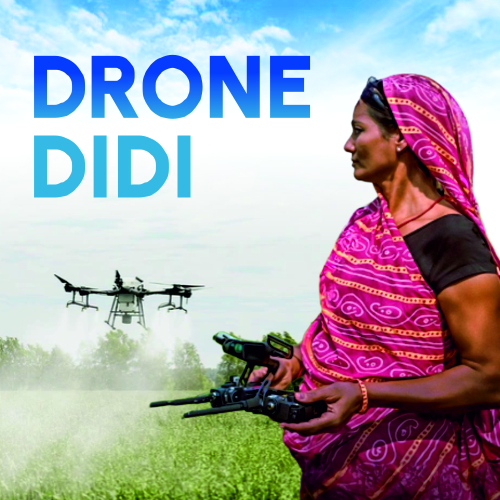
The Namo Drone Didi initiative connects this applied science with women’s participation. Approved in November 2023 with an outlay of ₹1,261 crore for 2023–24 to 2025–26, the scheme aims to provide drones to 15,000 women-led Self-Help Groups across India (Union Cabinet Secretariat, 2023; Government of India, 2023).
The scheme is structured around training. Women must complete DGCA-compliant certification before operating drones (Directorate General of Civil Aviation [DGCA], 2021). Training includes flight operation, safety standards, and spray calibration. Only after certification are drones deployed. As of February 2026, 57 drones are operational in Punjab and 102 in Haryana (Press Information Bureau, 2026).
This sequence ensures that drone operations follow regulated technical standards. Women are recognised as certified operators within a defined aviation and safety framework.
Women in Punjab and Haryana have always worked in agriculture. They participate in sowing, transplanting, crop care, livestock management, and post-harvest activities. However, formal systems often link recognition to land ownership rather than labour contribution. Land titles and machinery are frequently registered in male names, and the designation of “farmer” commonly follows ownership.
The Drone Didi initiative introduces a clear shift. When a woman becomes a certified drone operator, she takes on a defined technical role. She applies agronomic recommendations with calibrated precision. While she may not independently decide cropping patterns or marketing strategies, she directly influences how scientific advisories are implemented at the field level.
Her participation moves from informal labour contribution to recognised technical responsibility. It connects long-standing agricultural experience with structured scientific application.
Punjab and Haryana provide an important context for this intervention. Parliamentary data indicates that 1,021 drones were allocated to Punjab and 583 to Haryana (The Indian Express, 2024). These states combine high input use with narrow crop windows. Even small improvements in spray accuracy can produce measurable gains in efficiency and safety.
However, equipment alone does not ensure impact. Effective implementation requires coordination between skill institutions, rural development networks, and agricultural departments (Hindustan Times, 2024; Haryana Skill Development Mission, n.d.). Maintenance services, battery logistics, demand stability, and viable income models are necessary to sustain operations.
Providing a drone creates technical capacity. Sustaining its use requires institutional support and continuous integration into routine farming practice.
Drone spraying involves dosage calibration, drift control, canopy penetration, and safety compliance. These are applied scientific processes carried out under real farming conditions.
Women operators in Punjab and Haryana are implementing these processes directly in the field. Through structured certification and regulated practice, they are participating in applied agricultural science.
The significance of this initiative lies not only in technology distribution but in disciplined execution. The true test will be whether precision spraying becomes routine practice, whether certified women remain active operators, and whether agricultural systems become more efficient and accountable over time.
If this integration continues, women will not merely be associated with science — they will remain central to its practical application in India’s most critical production systems.
Directorate General of Civil Aviation. (2021). Civil aviation requirements (CAR) Section 3 – Air transport, Series X, Part I: Requirements for operation of unmanned aircraft system (UAS). Government of India.
https://www.dgca.gov.in/digigov-portal/?page=dgca/civilAviationRequirements/carSection3SeriesX
Government of India. (2023). Namo Drone Didi scheme. India.gov.in Spotlight.
https://www.india.gov.in/spotlight/namo-drone-didi
Haryana Skill Development Mission. (n.d.). Drone Didi scheme. Government of Haryana.
https://hsdm.org.in/doc/Drone_Didi_Scheme.pdf
Hindustan Times. (2024). Punjab Drone Didis take flight, enter new era of agri-tech empowerment.
https://www.hindustantimes.com/cities/chandigarh-news/punjab-drone-didis-take-flight-enter-new-era-of-agri-tech-empowerment-101755460833855.html
Press Information Bureau. (2026, February). Status update on Namo Drone Didi implementation. Government of India.
https://www.pib.gov.in/PressReleasePage.aspx?PRID=2227743®=3&lang=1
The Indian Express. (2024). Namo Drone Didi scheme: 1,021 drones allocated to Punjab, 583 to Haryana, says Centre in Lok Sabha.
https://indianexpress.com/article/cities/chandigarh/namo-drone-didi-scheme-1021-drones-allocated-to-punjab-583-to-haryana-says-centre-in-lok-sabha-10158568/
Union Cabinet Secretariat. (2023, November 29). Cabinet approves central sector scheme “Namo Drone Didi” to provide drones to 15,000 selected women Self Help Groups. Press Information Bureau.
https://pib.gov.in/PressReleasePage.aspx?PRID=1976559
By
Dr. Isha Jain
Senior Manager – Government Advisory